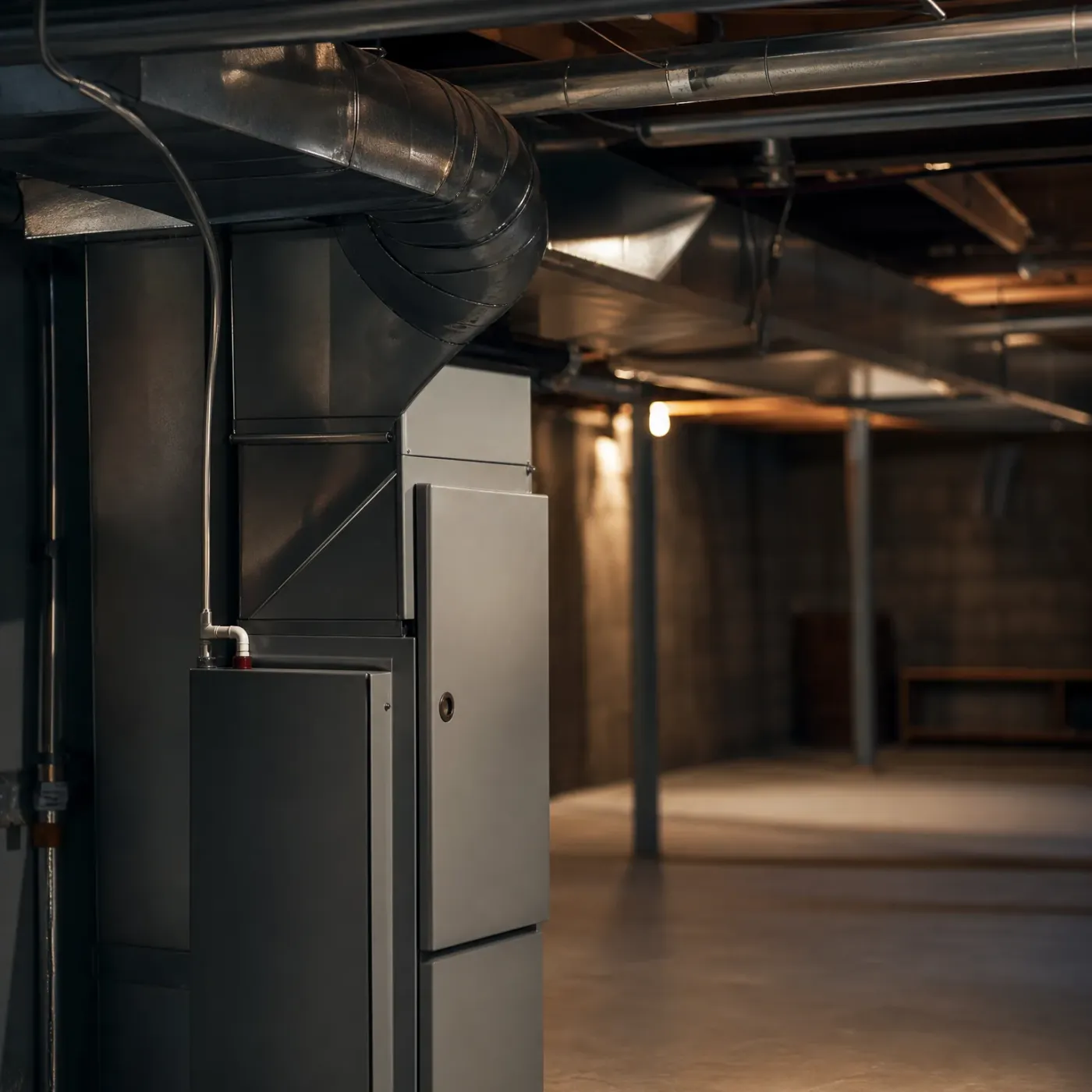







A basement interior with a gray furnace or air handler unit connected to large sheet-metal ductwork running along the exposed joist ceiling, with support posts and a concrete block wall in the dim background.

A local pro for your ductwork cleaning

Signs your ducts need cleaning in Farmington, NM

Dust on a windowsill a day after cleaning, a musty smell when the furnace kicks on, rooms that stay dusty no matter how often you vacuum. Those are the signs people in Farmington usually ask about. Below is what each one actually points to, and when it's worth getting a contractor out to take a look.

Request a pro

A few signs point straight to the ducts. Dust that settles back on furniture within a day of cleaning, even though the house is shut up tight, means air moving through the system is carrying more than it should. A musty or stale smell when the furnace or AC first kicks on is usually dust and debris inside the ducts heating up or getting stirred loose. Visible dust blowing out of the vents when you run the system, or a thick gray buildup right at the vent covers, is a direct sign. In Farmington's dry, dusty summers, ducts pull in more fine dust than homes in wetter climates, so buildup can show up faster here than it would elsewhere. If you or anyone in the house has noticed more sneezing or stuffiness indoors than seems normal, that fits the pattern too. None of these alone proves the ducts are dirty, but two or three together usually do.

Why does duct dust get worse here than it seems like it should?

  • Half the homes here were built by 1986

    Half the homes in San Juan County were built in 1986 or earlier. Original ductwork that age has had decades to collect dust nobody's seen.

  • Heat runs October through May

    Heat runs October through May here, about eight months a year. That's eight months of furnace air pushing through the same ducts.

  • Cooling runs June through August

    Cooling runs June through August. The system barely rests before heat season starts pulling dust through the ducts again.

ACS 2020-2024 · NOAA nClimDiv 1991-2020

Galvanized sheet metal HVAC ductwork and round pipes running along an exposed wood-joist basement ceiling beside a plain white wall.

Dust from the vents themselves

Hold a dark cloth near a supply vent after the system has run a while. If it picks up a layer of fine gray dust, that's coming out of the duct, not just settling from the room. Loose dust built up in the sheet metal breaks free when air moves fast enough, especially right after the furnace or AC first kicks on. A vent that stays clean to the touch, even with the system running, usually means the ducts aren't the problem.

Galvanized sheet metal HVAC ducts and round pipes installed among wooden joists on a ceiling, beside a large blank white wall.

No smell, no dust, no issue

Some homes run their ducts for years without any of these signs ever showing up. No musty smell at startup, no fast-returning dust, no vent grime. That usually means the ductwork is sealed well and whatever got into it during construction or past repairs never built up enough to matter. If that describes your house, cleaning isn't something the ducts are asking for. It's worth checking again if you've had work done on the attic, the crawlspace, or the system itself.

How do I know if it's actually my ducts and not something else?

Dust and smells can come from a lot of places in a house, not just the ducts. Before anyone pulls out a vacuum hose and starts charging for duct cleaning, it's worth knowing what actually narrows it down to the ductwork versus a dirty filter, a leaky duct, or just a dusty house.

Check the filter and the vents before you assume it's the ducts

A clogged filter causes a lot of the same symptoms as dirty ducts: dust, weak airflow, a musty smell when the system starts up. Pull the filter first. If it's gray and packed solid, replace it and see if the dust problem eases up over a week or two before you call anyone about the ducts themselves. If you've already swapped the filter and the house still dusts up fast, check the return vents for a thick coating of dust on the grille itself. That points to air pulling dust through gaps in the duct rather than the filter missing it. Smell is a better sign than dust alone. A musty smell that only shows up when the furnace or AC kicks on, and goes away once the system's been running a while, usually means something sitting in the ducts, not somewhere else in the house.

  1. A technician seals the vents and sets the system to negative pressure.

  2. A vacuum collector hooks to the main trunk line near the furnace.

  3. Agitation tools knock loose dust stuck to the duct walls.

  4. Loosened debris pulls through the ducts into the vacuum collector.

A smiling bearded man in a dark long-sleeved shirt sits on a brown leather sofa in a living room, with a large glass bowl of popcorn on a table in the foreground and a houseplant and doorway behind him.
A smiling man with gray-streaked hair and a beard in a dark blue sweater reclines on a sofa in a living room with a lit wood stove, shelves, wicker baskets and a bowl of popcorn on a table.
A smiling bearded man in a dark plaid shirt sits on a green couch beside a cushion and a wooden bowl of popcorn, with a blurred kitchen and living area behind him.
A smiling bearded man in a dark green henley shirt sits on a gray couch in a living room with a bookshelf, lit lamp, houseplant and framed picture behind him, and a bowl of popcorn in the foreground.

What built-up dust does to airflow

Ductwork caked with dust loses some of its effective width, the same way a straw clogs when you pack it with lint. The blower has to push harder to move the same volume of air. Rooms farthest from the furnace often run a few degrees off from the rest of the house, and the system runs longer to catch up. That extra runtime doesn't just show up on the utility bill. It puts more hours on the blower motor and the furnace itself, year after year, than a clear system would.


Why vents matter more than filters

A filter only catches what passes through it on the way to the furnace. It does nothing for dust that's already sitting in the supply ducts, which gets pushed straight into rooms every time the system kicks on. That's why a house can have a fresh filter and still show dust on the windowsill the next day. The return side pulls air back in, carrying whatever's loose in that run of duct too. Cleaning the vents and the filter are two separate jobs, and one doesn't substitute for the other.

A woman with wavy brown hair sits on a beige couch with her eyes closed and a slight smile, a knit blanket over her lap and a closed dark-covered book resting on it, with a lit lamp and plant in the dim background.
A smiling man with dark wavy hair and a short beard, wearing a navy crewneck sweater, sits at a candlelit dinner table with a bowl of food, wine glass and a lamp and framed art behind him.

Get the right pro for your ductwork

Send the form and the duct cleaning stops sitting on your list.

Sending the form costs nothing.

Unfinished basement with galvanized sheet-metal rectangular and round ductwork running along a wood-joist ceiling, two steel support columns, a small window, and a furnace unit against the far right wall.

Ductwork that's keeping up

Clean steel trunk lines and tight flex runs move air the way they were sized to. No fur lining the inside of the metal, no gray residue around the seams. Air comes out of the vents the same as it went in, and the blower isn't working any harder than it has to.

An unfinished basement with bare concrete walls and floor, showing exposed wooden floor joists, pipes, wiring, and metal HVAC ducts with a vent grille overhead.

Ductwork showing its age

Branch ducts packed with years of dust narrow the path air has to travel through. Joints that have loosened over time leak conditioned air into the joists instead of the room it was meant for. Either one shows up as weak airflow at the vent farthest from the furnace.

Is the dust in your house actually coming from your ducts?

Walk through the house and check a few rooms you don't use every day. A guest bedroom or a home office with the vent closed most of the year often has the heaviest buildup on the sill and the furniture, because the dust sitting in that duct run has nowhere else to go. Check the return vent too, the big one the furnace pulls air through. A thick mat across the grille, especially with pet hair woven into it, means that's what's getting pulled into the system every time it runs. If anyone in the house has started sneezing more at home than away from it, or a cough shows up mostly in the evening when the furnace or AC has been cycling for hours, that's worth paying attention to alongside what you're seeing on the furniture.

Unfinished basement with bare concrete walls and floor, showing exposed wood floor joists overhead with sheet-metal rectangular ductwork, insulated flexible ducts, and pipes.

Ducts doing their job

Steel trunk lines and flex runs sit open in the joists, same as the day they went in. Air moves through at full width, no drag, no buildup lining the metal. The blower pulls the amount of air it was sized for and every room gets its share, near the furnace or far from it.

Basement ceiling with galvanized sheet metal rectangular ducts and round pipes running between wooden joists above a bare concrete wall and floor.

Ducts carrying buildup

The same run of trunk line and flex pipe, but years of dust have settled along the seams and the inside walls. The path narrows. Air has to push through a smaller opening to reach the same vents, and whatever's loose in there rides along with it into the rooms.

A woman in a cream sweater stands in an open doorway of a single-story house with horizontal siding and a stone-veneer base, facing a man in a blue shirt with a bag strap seen from behind in the foreground.

What it looks like in your own house

Check your own register covers before you check anything else. Pull one off in a room you use every day and look at the inside edge of the boot. A thin gray fuzz there is normal. A hard crust, or dust thick enough to hide the metal color, means it's been building for a while and the blower has been pushing air through it the whole time. Look at your air filter too. If it's gray and matted well before the date you'd normally change it, the ducts are likely feeding dust back into the system faster than the filter can catch it.

None of this tells you on its own whether what you're looking at needs a full cleaning or just a closer look from someone who does this for a living. That's the part worth handing off. Once you send in what you've noticed, a contractor who works on ductwork in your area takes it from there and reaches out to go over it with you, so you're not the one trying to figure out which signs matter and which don't.

A gray upholstered sofa with a textured cushion sits beside a dark round side table holding a vase of green foliage, with a table lamp and sheer-curtained window behind.

Power here costs 13.92 cents per kilowatt-hour

At 13.92 cents per kilowatt-hour, a blower working harder to push air through clogged ducts shows up on your bill. Clean ductwork means the system reaches every room without straining, so you're paying for air that actually gets where it's going.

EIA-861 2025

What the signs are telling you

  • Dust that resettles within a day, a musty smell at startup, and heavier buildup in rarely used rooms all point the same direction.
  • A dark cloth held near a supply vent that picks up gray dust is a straightforward way to check for yourself before anyone comes out.
  • Weak airflow in rooms farthest from the furnace often traces back to ducts that have lost some of their effective width.
  • None of these signs require guessing once you know what to check, and most take a few minutes to look at.
  • Getting matched with a contractor means you're not the one tracking down who's available or chasing a callback.
  • Once the signs point to the ducts, the next step is someone who can confirm it and clean them properly.

Everything above comes down to a short list. Dust that settles back fast, a musty smell when the system starts, rooms that run weak on airflow, a gray coating inside the register boot. Any one of these on its own might mean something else in the house. Two or three together, in a home with the original ductwork, usually mean the ducts.

You don't need special tools to check most of it. A dark cloth by the vent, a look inside the register boot, a walk through the rooms you don't use every day. Ten minutes tells you more than guessing ever will. If what you find matches what's listed here, the dust and the smell and the weak airflow in the back bedroom all have the same source, and it's one a vacuum and some agitation tools can fix, not a problem with the house itself.

From here, the work isn't yours to chase down. Once you send the form, you're not the one calling around San Juan County trying to find someone free this week. A contractor who handles this gets your information and reaches out. You've already done the part that mattered, which was figuring out whether this was worth looking into at all. The rest is a phone call you didn't have to make yourself, and ductwork that goes back to moving air the way it was sized to the day it went in.

A white clapboard house with black-trimmed windows and a dormer, photographed at dusk with lit windows, an illuminated porch and dark front door, flanked by potted hydrangeas, a stone walkway, clipped hedges and lawn.

Ductwork Cleaning

A pro who works on ducts

Duct and vent cleaningDucts or ventsSan Juan County, NM
Step 1 of 2

What ZIP code is the job in?

  • A beige upholstered armchair with a green cushion and a knitted throw sits beside a window with a rain-speckled pane, with a lit table lamp and bookshelf behind and a wooden side table holding a ceramic mug and a book.
    • Your request goes to a San Juan County pro who takes ductwork jobs.
    • Get matched with someone who does this kind of work in San Juan County.
  • A ceramic table lamp with a wide linen shade and a dark wooden bowl sit on a round wood side table beside a beige upholstered sofa with a chunky knit throw, in front of a curtained window.
    • After this form, you can stop searching for a duct system pro.
    • One request and the search for a pro is handled.
  • A living room with a light gray sectional sofa holding brown and cream textured pillows and a knit fringed throw, a rustic wood coffee table with stacked books and a stone vase of olive branches, built-in shelves with pottery, and a tall olive tree beside a curtained window.
    • Answer a few questions instead of calling shop after shop.
    • Describe your ductwork job once, to one pro.
  • A ceramic urn-shaped table lamp with a mottled gray glaze and beige drum shade sits on a dark wood side table beside a potted green plant, next to a light beige upholstered sofa and a framed artwork on a gray wall.
    • Your request goes to one pro, not a list of companies.
    • The pro who gets in touch is licensed in New Mexico and works in San Juan County.