Mold in air ducts in Rio Rancho, NM

Once you send the form, finding a pro is off your list.

Hand it off

Mold in air ducts usually means moisture got in somewhere it shouldn't. In Rio Rancho, that's often condensation around the AC coil or ductwork running through a space that doesn't breathe well, especially after a stretch of monsoon humidity breaks up the dry summer air. Mold needs moisture to grow, and dust in the ducts gives it something to feed on. If you've noticed a musty smell when the air kicks on, or dark spots around vent covers, that's usually where it's coming from. It won't fix itself. Mold in the ductwork keeps circulating spores through the house every time the system runs, and the longer it sits, the more of the duct surface it can spread across. Cleaning the ducts and finding what let the moisture in are the two things that actually stop it. One without the other means it comes back.

Why would mold be growing in your ducts?

  • Half the homes here were built by 1997

    Half the homes in Sandoval County were built in 1997 or earlier. Ductwork that old has had decades to develop gaps or seams where moist air seeps in and settles.

  • Heat runs October through May

    Furnaces here run about eight months a year, October through May. That's a long stretch of air moving through the same ducts, carrying any moisture or growth right into every room.

  • Cooling runs June through August

    AC runs June through August, right when monsoon humidity is heaviest. That's when condensation forms on the coil and ductwork, giving mold the moisture it needs to grow.

ACS 2020-2024 · NOAA nClimDiv 1991-2020

Dusty ducts versus moldy ducts

Dust in a duct is dry. It builds up on the sheet metal, gets stirred when the blower kicks on, and settles again when it shuts off. It doesn't smell like much beyond ordinary dust, and it doesn't come back fast once a duct's been cleaned out. Mold needs standing moisture to keep going, so it shows up in one section, usually near the coil or a run that sits in a space that doesn't dry out, rather than spread evenly through the whole system. If you open a vent cover and see dark spotting that looks wet or feels tacky, that's not dust. That's a colony that's been feeding on moisture for a while, and it needs more than a vacuum.

Musty smell versus visible growth

A musty smell with nothing to see can mean mold is growing somewhere in the ducts you can't reach by eye, often past the first bend or inside the coil housing. The smell is usually strongest right when the furnace or AC first kicks on, then fades as air moves through the house. Visible growth at a vent cover tells you the problem has spread close enough to the opening to show itself, and by that point it's usually been there long enough to have spread further upstream too. Either way points to the same cause, moisture sitting somewhere in the system, but a smell with no visible sign often means the growth is worse, not better, because it's had time to establish itself out of sight.

Basement ceiling with galvanized sheet-metal ductwork, wooden joists and subfloor, black and white pipes, above a concrete wall and floor.
Before you get your ductwork cleaning
Unfinished basement with bare concrete walls and floor, exposed wood joists, and galvanized sheet-metal HVAC ductwork and pipes running across the ceiling.
After you get your ductwork cleaning

Mold doesn't stay put once it's growing in a duct. Every time the blower runs, it pushes spores out through the vents and into the air you're breathing in every room the system reaches.

Cleaning removes what's already growing and coating the sheet metal, but it doesn't change the moisture that let it start. Whatever let water in around that coil or seam still needs to get fixed, or it comes back.

Power here costs 16.32 cents per kilowatt-hour

At 16.32 cents per kilowatt-hour, running a blower longer than it needs to costs real money. Mold-coated ducts make your system work harder to push air through, and a dirty coil downstream forces the blower to run longer to reach the same temperature. Clearing that buildup lets air move the way the system was built to move it.

EIA-861 2025

Empty unfinished basement with bare concrete floor, insulated walls with vapor barrier between wood studs, exposed wood joists, galvanized sheet-metal ductwork, a recessed light, and a steel support column.

Ductwork running clean

This is what ducts look like when they're doing their job. Air moves through the metal and flex runs without picking up anything along the way, and the joists and insulation around them stay dry. No damp smell when the blower kicks on, no buildup inside the seams.

Empty basement room with bare concrete walls and floor, exposed wooden floor joists overhead, large galvanized sheet-metal ducts with a vent grille, colored pipes, and a single lit bulb.

Ductwork holding moisture

Bare concrete walls and a slab floor hold moisture longer than a finished basement does, and that dampness sits against the duct runs overhead. Give mold a seam to settle into and it keeps going, coating more of the sheet metal each month the ducts run.

What does mold in your ducts actually look and smell like at home?

Walk past a vent when the blower is running and take a breath. A musty, damp smell that gets stronger near the registers and fades when the system shuts off is usually mold, not just dust. Some homes notice it most in a bedroom or office with a single supply vent and not much airflow. Pull a vent cover and look at the inside edge of the duct; dark spots, a fuzzy gray or black coating, or streaking around the seams are signs of growth, not soot. You might also notice more sneezing or a stuffy feeling indoors than you'd expect, especially right after the furnace or AC kicks on. Left alone, it keeps spreading across the sheet metal and insulation around the ducts.

Unfinished basement with bare concrete floor and walls, exposed wood joists, large galvanized sheet-metal ductwork, PVC and copper piping, and a gray furnace unit beside wood stud framing.

Ductwork working the way it should

A dry basement with the furnace and ducts in plain view. The sheet metal stays clean, the joists around it stay dry, and the condensate line drains where it's supposed to. Nothing here feeds mold a reason to start.

Basement ceiling with large galvanized sheet-metal ductwork, round metal pipes and plumbing lines running beneath wood joists, above a bare concrete wall and floor.

Ductwork with a moisture problem

Look up at the joists and you can see the staining on the foundation wall behind the ducts. Water has been getting to wood and metal it shouldn't reach, and wherever it's sitting on the duct seams, mold has what it needs to keep growing.

A smiling man with short dark curly hair and stubble, wearing a navy T-shirt, sits on a beige sofa looking down toward a dark object in the foreground, with a living room, round mirror, lamp and bright window behind him.
A bearded man in a red and dark plaid flannel shirt looks out a frost-edged window at a snow-covered yard, with a gray mug on the sill in the foreground.
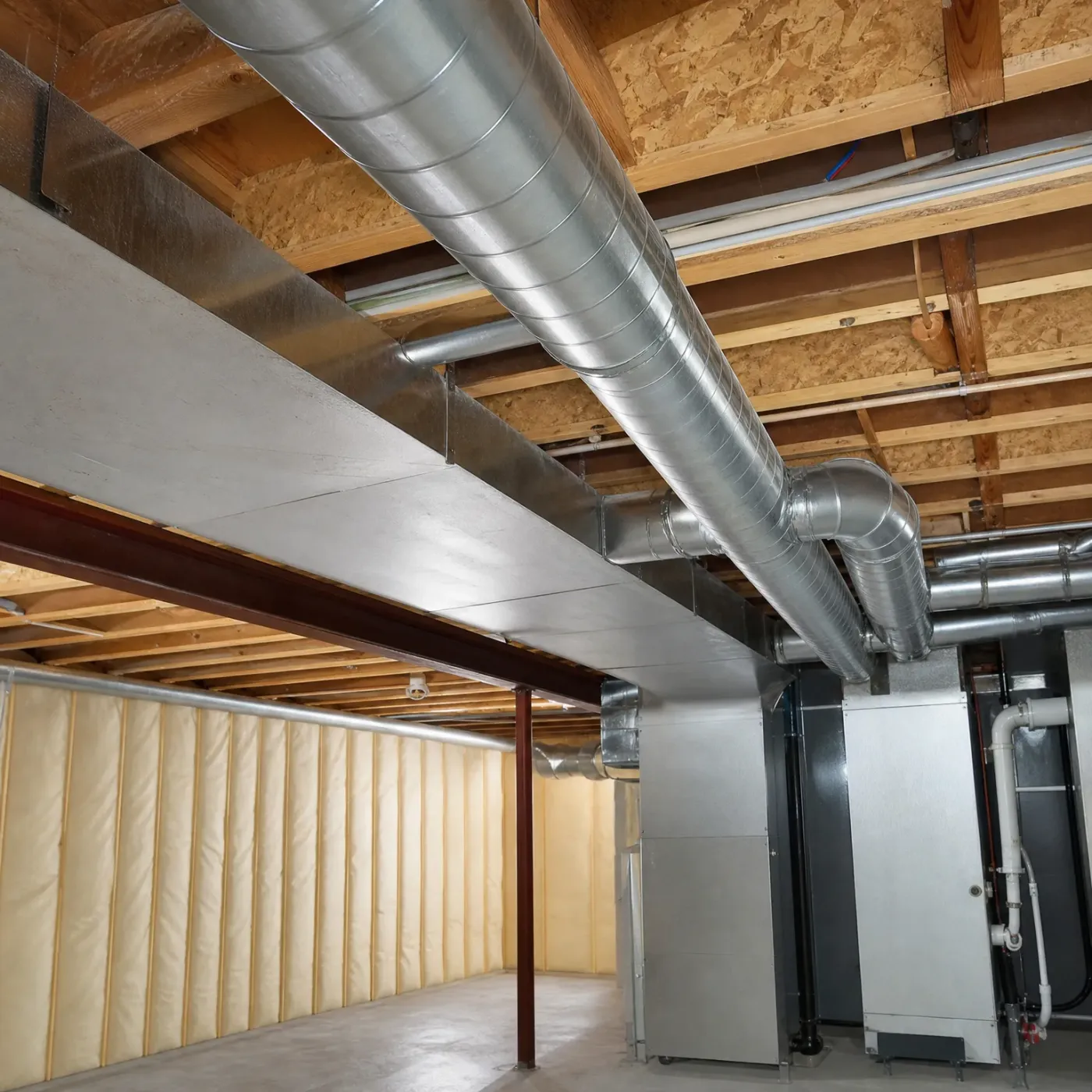
Unfinished basement with exposed wood floor joists, galvanized round and rectangular ducts, insulated foundation walls, a steel beam with support post, and mechanical equipment with piping at the right.

It's off your list after this

The pro who gets in touch is licensed in New Mexico and works in Sandoval County.

After you send the request, you're done searching.

Hand off the search

You only hire the pro if you want to.

How does mold actually spread through the duct system?

You found mold in one register or one return, and now you're wondering if it's really spreading through the whole system or if it's just sitting there in that one spot. It matters for how you think about cleaning, because a patch of mold behind one vent is a different problem than mold riding the air to every room.

Every time the blower runs, it carries spores from wherever mold is growing out through the supply ducts and into every room on that system

Mold doesn't need to grow in every duct to end up in every room. Once it takes hold on one section of sheet metal, often near the coil or a cold spot where condensation collects, the blower does the rest. Air moves across that spot, picks up spores, and pushes them down the supply runs to whatever registers the system feeds. The return side pulls air back the same way, so a patch of mold near the furnace can touch rooms on the far side of the house. It settles out on furniture and floors between cycles, then gets stirred up again the next time the system kicks on. That's why a smell near one vent usually means the air everywhere in the house has already carried some of it.

A dimly lit interior wall with a ceiling air vent above a wooden sideboard holding a potted plant, a shallow bowl, and a table lamp beside a curtained window.

Spring afternoon, and the sun through the living room window catches it: a gray film laid out on the end table and the arm of the couch, the kind that wasn't there a few days ago. You look up at the ceiling vent and the grille is dusted dark around its edges, more than dust usually sits there. The furnace hasn't run in weeks, but the blower cycled through the night for the AC, and something came down with that air. You run a finger along the table and it comes back gray. Outside, Rio Rancho is dry and warming toward summer. Inside, nothing feels right about where this is coming from.


Empty basement with bare concrete walls and floor, a small window at left, and exposed wood joists with galvanized sheet metal ductwork and pipes overhead.
Ducts installed clean, metal bright and joints sealed, nothing yet for mold to feed on.
Dusty sheet-metal HVAC ducts with a rectangular vent register run beneath wooden floor joists above an empty concrete-walled basement.
Ducts coated dark with grime, the kind of film that holds moisture and lets mold take hold.

Where this leaves you

  • Mold in a duct means moisture found its way in, usually at the coil, a condensate line, or a seam in older ductwork.
  • A musty smell at the registers that fades when the blower shuts off is the clearest sign something is growing, not just dusty.
  • Once mold takes hold, every blower cycle carries spores out through the vents and into the rooms the system reaches.
  • Cleaning strips what's already coating the sheet metal, but it won't hold if the moisture that fed it is still there.
  • A system clear of mold moves air without resistance, which is one less reason for the blower to run longer than it has to.
  • What matters now is whether the ducts get cleaned before the problem spreads further through the system.

Mold in a duct always starts with water somewhere it shouldn't be. Sometimes that's condensation off the AC coil, sometimes it's a seam in ductwork old enough to have settled and gapped, sometimes it's a condensate line that isn't draining the way it should. Finding where the moisture got in matters as much as cleaning out what it grew. The smell is usually the first clue. Musty air near a register that clears up once the blower shuts off points at something living in the duct, not dust sitting still on the metal. Once that's growing, it doesn't stay in one spot. Every time the system cycles on, it pushes spores through the vents and into whatever room that line feeds, which is why one bad return or one bad register can end up affecting the whole house. Cleaning takes care of what's already there, the coating on the sheet metal, the buildup around the coil, the growth in the seams. It makes the ducts move air the way they're supposed to, without the extra resistance that makes a blower run longer than it needs to. But cleaning alone doesn't fix a coil that keeps sweating or a line that keeps leaking. If that part of the problem is still there, mold has every reason to come back. The question in front of you now isn't whether to deal with it. It's whether the ducts get cleaned before more of the system picks up what's already growing in part of it.

A smiling man in a green ribbed sweater stands behind a wooden table holding a ceramic mug of coffee in a kitchen with white subway tile, shelves of potted plants, and a bowl of fruit.
A smiling man with dark curly hair and a beard, wearing a dark green knit sweater, stands at a white marble kitchen counter with a dark blue mug, with open shelving, pendant lights and a houseplant behind him.
A smiling bearded man in a green henley shirt stands at a kitchen island with a gray mug, looking off to the side, with a dining area and shelves blurred behind him.
A smiling man in a navy long-sleeve shirt sits at a wooden table in a kitchen and dining area, with a ceramic mug, a potted plant, and a sliding glass door behind him.

Ductwork Cleaning

Stop chasing a duct system pro

The pro who reaches out is licensed in New Mexico.

A black-framed smartphone standing upright against a plain light gray background, its screen filled with solid green.
Duct and vent cleaningDucts or ventsSandoval County, NM
Step 1 of 2

What ZIP code is the job in?