New Mexico HVAC Pros

Birds nesting in a dryer vent in New Mexico

A square stainless steel wall vent hood with a hinged flap cover and a round mesh-screened duct opening, shown centered against a plain light gray background.
Hand it off

Why do birds keep building nests in my dryer vent?

You keep clearing out your dryer vent and birds keep coming back to it. It's more than an odd coincidence. A vent on the outside of your house looks a lot like a hollow tree or a ledge to a bird looking for shelter, especially once one has already built there and left a sign for the next one. Before you pull more nest material out, it helps to know why your vent keeps attracting them.

Your dryer vent looks like a ready-made nest site to a bird

A dryer vent hood has a small opening, a dark space behind it, and some shelter from weather, which is close to what a bird looks for in a nesting spot. In New Mexico, that opening also offers shade and a break from the summer heat, so it draws attention from birds looking to get out of the sun. If the flap on your hood doesn't close all the way, or sits bent or propped open from old lint buildup, a bird can get in and out with no trouble. Once a nest has been built there once, feathers and old material left behind make the spot easier to find again, so the same vent often gets used more than once unless the hood and the flap get fixed.

A metal hooded dryer vent with a louvered opening mounted on beige horizontal lap siding above a concrete foundation wall.

Clear vent, flap moves

The cap sits flush against the siding and the flap swings free when the dryer kicks on. Air pushes straight out and shuts again after each load. Nothing for a bird to grab onto or build against, so it stays open ground instead of a nesting spot.

A white hooded dryer vent mounted on horizontal lap siding, with a thick mass of gray lint clogging the opening beneath the hood.

Nest blocking the flap

Lint has packed in behind the flap until it can't close all the way, which is exactly what a bird is looking for. A gap held open by debris reads as shelter. Once a nest starts, the blockage only gets worse and the dryer has to push harder to vent at all.

Clear It Yourself or Call for a Cleaning

Clear it yourself

  • A broom handle or a shop vac hose can pull loose straw and twigs out of a vent you can reach from a ladder.
  • You find out fast whether the nest is old and empty or a bird is still sitting on eggs inside it.
  • Without a camera you can't see how far back the blockage goes or whether droppings and feathers have packed the duct itself.
  • A nest pulled from the hood doesn't tell you if the flap still swings freely or if it's bent from being pried at.
  • Dry summers here mean nesting material is tinder next to a heat source every time the dryer runs.
  • If the duct run is long, what you clear from the outside may be only the first foot of a much longer problem.

Have the vent cleaned

  • A camera run through the duct shows nesting material anywhere along the line, not just what's visible at the hood.
  • Someone who services vents all summer knows the nests show up in the same spots year after year and checks there first.
  • The full duct gets cleared, not just the opening, so lint built up behind an old nest comes out too.
  • A local contractor can look at the cap and flap while they're out there and tell you if it's sitting right or needs replacing.
  • One company handles the job instead of several crews calling about the same request.
  • Gas dryers depend on that vent running clear to push exhaust out, so a full clearing matters more than it would with an electric one.
A white louvered dryer vent hood mounted with four screws on beige horizontal lap siding above a gray stucco foundation and concrete walkway.

The flap still swings free

Four screws hold the hood flat against the siding, and the louvers stay clear. Nothing is wedged behind them or poking through. Air has a straight path out whenever the dryer runs.

A white plastic dryer vent hood mounted on beige horizontal vinyl siding, with lint clogging its lower opening and a concrete foundation below.

Lint has sealed the opening

The cover is caked in gray lint and the opening is packed shut. Nothing here is moving air out anymore, and nothing is stopping a bird from treating it as a cavity worth building in.

Is something blocking my dryer vent right now

A load that used to take forty minutes now takes an hour or longer, and the dryer feels hot to the touch partway through. You pull lint off the trap every time and it still doesn't seem to help. Outside, you might hear soft scratching or chirping from the vent hood when the house is quiet, or notice straw and twigs poking out from behind the flap. Sometimes a dead bird or an old nest from a prior season is the only thing stopping that flap from closing all the way. None of it clears on its own, and a vent that can't push air out properly is also pushing heat and moist air back into the dryer every time you run it.

A smiling man in a dark green shirt over a white t-shirt sits at a kitchen counter with a dark mug, looking off to the side, with shelves, plants and a bright living area behind him.
A man in a gray long-sleeve waffle-knit shirt smiles and looks off to the side in a kitchen with open shelving, a refrigerator, a wooden sideboard with a potted plant, and a glass door to the right.
A man in a dark green ribbed sweater stands smiling and looking off to the side beside a stone kitchen counter with a ceramic mug, with a dining table, pendant lights, and large windows in the background.
A bearded man in a gray long-sleeve shirt stands smiling and looking off-camera beside a kitchen counter with a white mug, with a living room, fireplace and wall-mounted television behind him.

One request and it's handed off

A nest built once in the spring usually comes back the next year, because the vent still looks like good shelter to whatever bird finds it next. Every season it sits blocked, your dryer is pushing hot, wet air into a space with nowhere to go, and in a dry New Mexico summer that's more heat for a machine already working against the weather outside. Pulling twigs out with a broom handle gets the visible stuff, but it won't tell you if lint has packed in behind the nest or if the flap is bent enough to let the next bird back in. A local contractor who clears vents all season knows what a New Mexico nest looks like compared to a lint blockage, and can check the cap and the full run of duct while they're at it. One request goes to one licensed contractor near you, not a handful of companies competing for the job. Send it and this stops being something you have to climb a ladder for again.

  1. A bird carries straw and twigs into the vent hood opening.

  2. Nest material packs against the flap, propping it open.

  3. Lint drifting through the duct catches on the sticks and builds up.

  4. Airflow drops, so the dryer runs hotter and takes longer.

A smiling man in a dark blue T-shirt sits on a light gray sofa in a living room with a wooden shelf and window behind him, with a laptop edge visible in the foreground.
A bearded man in a plaid flannel shirt sits indoors looking out a window at snow-covered trees, with a steaming mug on the sill and wooden kitchen shelves behind him.
A white hooded dryer vent with a louvered grille screwed to beige horizontal lap siding above a lighter foundation wall.
The hood sits flush against the wall and the flap hangs loose, open only when the dryer pushes air through it.
A wall-mounted plastic dryer vent hood on light-colored horizontal vinyl siding, clogged with lint and debris hanging from its opening, above a gray painted foundation.
Sticks and lint pack the opening solid, and the flap can't close over what's wedged behind it.
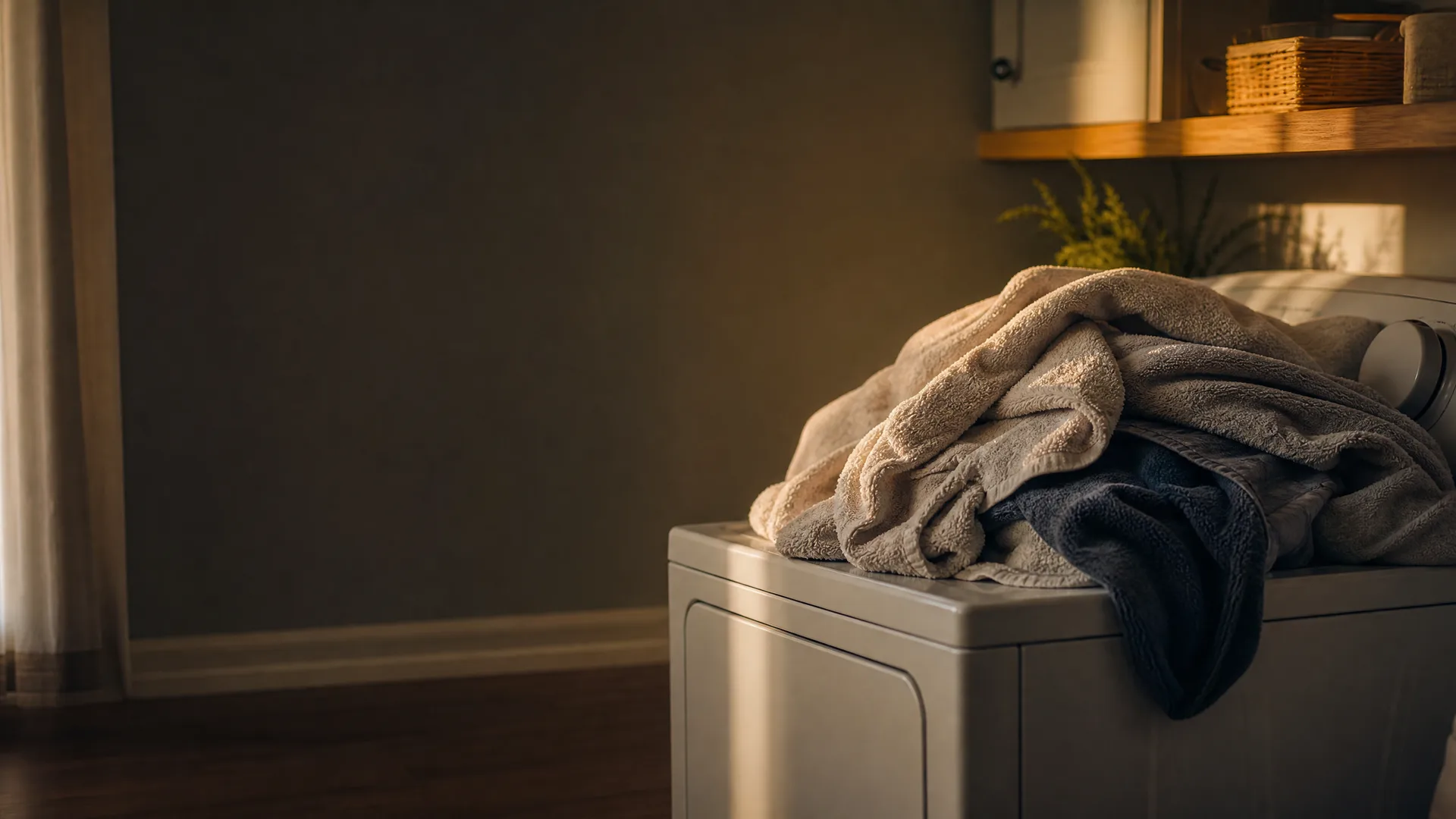
A pile of beige and navy towels sits on top of a white top-loading laundry machine in a dim room with a dark wall, wood floor, and a wooden shelf holding baskets and a plant.

You're moving the second load along at seven on a Tuesday, and the first load is still sitting on top of the dryer in a heap, towels gone cool and damp instead of warm. You go to switch loads and the ones already run feel wrong, heavier than they should, like they never finished. The air coming off the dryer is warmer than usual against your hand. Outside the window the evening light is flat and dry, the way it gets here most of the year, and you can hear something scratching faintly behind the wall where the vent runs. You push the damp towels aside to make room for the next batch and tell yourself you'll look at the vent cap before you run another load.


Power costs 14.85 cents per kilowatt-hour statewide

At 14.85 cents a kilowatt-hour, a dryer fighting a blocked vent costs you more every load, not just more time. The motor runs longer to push air through nest material, and that extra runtime is what shows up on your bill.

EIA-861 2025 statewide residential average

A bird built a nest where your dryer vents outside, and the fix is getting that vent clear and the airflow moving again. That's a cleaning job, and it's one a local contractor handles on a regular basis, not an unusual call. Someone who services dryer vents across New Mexico all year knows this pattern well, the hood that looks like a ledge, the flap propped open by sticks, the lint that catches on nest material and builds from there. You'll be matched with one licensed contractor local to you, not a list of companies competing for your callback, so the person who shows up already has a sense of what they're looking at before they pull the hood off the wall. Clear the nest now and the vent goes back to doing what it's supposed to do, pushing hot, damp air straight outside instead of trapping it behind a blocked flap. Nothing about the vent changes next spring on its own, but the problem in front of you right now has a straightforward answer.

A single-story stone-clad house with low-voltage path lights along a gravel bed and lawn at dusk, with a tree line and orange sky on the horizon.

Dryer Vent Cleaning

Done looking for a dryer vent pro

Duct and vent cleaningNew Mexico
Step 1 of 3

What kind of equipment?

  • A gray upholstered sofa arm with a cream knit fringed throw sits beside a wooden side table holding a stack of books, a shallow wooden bowl, and a ceramic vase of leafy branches, on a wood floor near a window.
    • A local pro who cleans dryer vents gets in touch with you.
    • Your dryer vent cleaning request goes to a local pro who does this work.
  • A living room corner with a cream upholstered sofa and cushion beside a wooden side table holding a ceramic vase of olive branches and a small dark bowl, with a framed landscape painting on the gray wall and a linen curtain at the window.
    • Once you send the form, finding a pro is off your list.
    • After you send the request, you're done searching.
  • A wood-framed armchair with a beige cushion and knitted throw sits beside a round wooden side table holding a ceramic mug, with a potted green plant near a window in the corner and a framed picture on the wall.
    • Skip calling around for someone who cleans dryer vents.
    • Answer a few questions about the dryer vent cleaning and skip the search.
  • Interior corner with beadboard wainscoting, a gray cabinet with wood countertop holding a vase of greenery below a window, and a potted leafy plant in a woven basket on a wood floor with a fringed jute rug.
    • The pro who reaches out is licensed in New Mexico.
    • Only one pro gets your request, so you hear from one company.