

New Mexico HVAC Pros

Is a clogged dryer vent a fire risk in Las Cruces, NM

Skip the calls

Yes, a clogged dryer vent is a fire risk, and that's likely what brought you here. Lint builds up in the duct, the airflow backs up, and the heat has nowhere to go. In Las Cruces, where summers already push your utility closet hot, a blocked vent makes it worse. You could start calling around Doña Ana County for someone to clean it, explaining the same thing to each one and waiting on quotes that are hard to compare. Or you can skip that part. Tell us what's going on and you'll hear from one licensed local contractor, not a handful of them competing for your callback. Someone who services these vents all year in this area, who knows what a lint-packed duct looks like after a hot Las Cruces summer and a cold winter of heavy drying. Answer a few questions and get matched.

Yes, a clogged vent is a real fire risk, not a worst-case exaggeration. Lint is paper-thin and catches fast, and once airflow is choked, the dryer's heating element keeps firing into a duct that can't carry the heat away. That heat has to go somewhere, and in a long duct run packed with lint, it builds right at the point where the clog sits. Most homes in Las Cruces run the dryer hard through the summer heat and into the cold months too, so the vent rarely gets a break to begin with. A dryer that takes two cycles to dry a load, or feels hotter than usual in the laundry room, is already telling you the vent is restricted. The fix isn't complicated. It's getting the duct cleared out before lint has months to keep piling up behind whatever is already blocking it.

A white hooded dryer vent with a louvered opening mounted on light beige horizontal lap siding above a concrete foundation and sidewalk.

The louvers open and close with the airflow

This is what a clear vent looks like from outside. The cap sits flush, the louvers swing open when the dryer runs and fall shut when it stops. Air and heat move out in a steady stream, nothing holding them back.
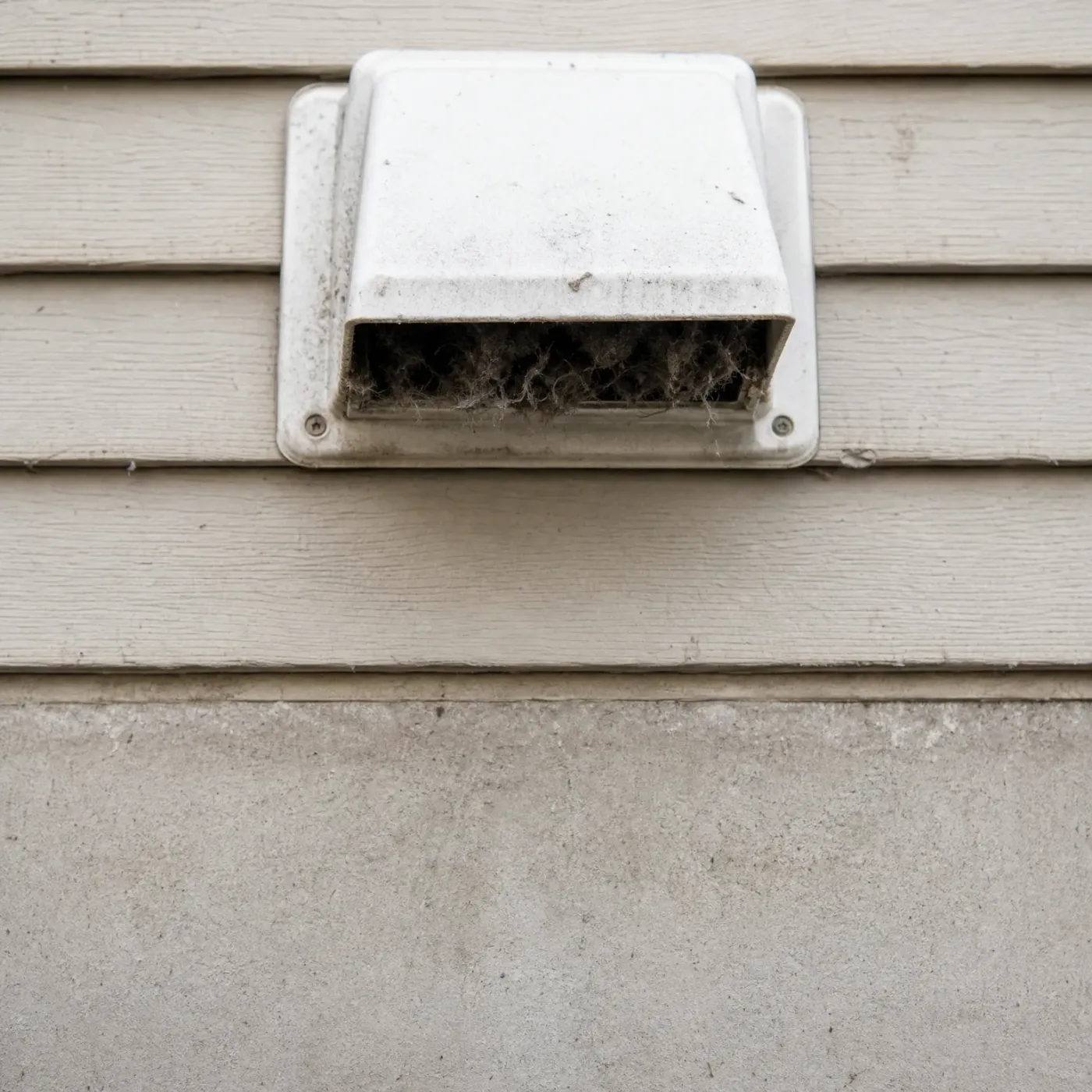

A white plastic dryer vent hood clogged with grey lint, mounted on beige horizontal lap siding above a concrete foundation wall.

Gray lint has already sealed the opening

Here the louvers can't close because lint is packed across the whole opening. Air that should be leaving the house is pushing against that mat instead, and so is the heat the dryer is putting out with every load.

How many loads a day is your vent actually clearing?

  • 2.58 people per household on average

    With 2.58 people in the average Doña Ana County household, that's laundry most days of the week, and every load leaves lint behind in the duct whether you notice or not.

  • Half the homes here were built by 1991

    Half the homes here were built in 1991 or earlier, which means the duct run was put in decades ago and may never have been cleaned since.

  • Power here costs 11.06 cents per kilowatt-hour

    At 11.06 cents per kilowatt-hour, power here is cheap, so a clogged vent won't show up as a spike on your bill before it shows up as a fire risk.

ACS 2020-2024 · EIA-861 2025

A metal hooded dryer vent with a louvered opening mounted on gray horizontal lap siding, next to a plain off-white wall.

Why lint catches so easily

Lint is made of short cotton and synthetic fibers that have already been through a hot, dry cycle. It has almost no moisture left in it and it sits loose in the duct, so it takes very little heat to set it off. A gas dryer's igniter runs well above the temperature lint needs to burn. Once airflow is restricted and heat has nowhere to vent, that lint is sitting right next to the one thing that can light it.

A stainless steel hooded dryer vent screwed to light gray horizontal lap siding, with a blank white wall occupying the left side of the frame.

The duct run matters too

A straight, short duct clears lint with every load. Longer runs, or ones with several turns to reach an outside wall, give lint more surface to catch on along the way, and corners collect it faster than straight pipe. If your dryer sits on an interior wall or in a closet, the duct likely has at least one bend before it reaches outside, which is one more place for lint to build up unseen.

How does a clogged dryer vent actually start a fire?

You want to know how a clogged dryer vent actually start a fire?

Trapped heat ignites the lint itself, inside the duct

A gas dryer's burner or an electric dryer's heating element cycles on and off to keep the drum at a set temperature. With a clear vent, the hot air leaves as fast as it's made. With a clogged one, that air backs up into the duct, and the temperature inside climbs past what the lint sitting there can take. It doesn't need an open flame. The heat alone is enough, and once it catches, the duct feeds it a steady path of more lint and moving air. The fire starts inside the vent itself, often behind the wall, which is why it can burn for a while before anyone in the house smells or sees anything.

A smiling woman with long brown hair in a cream sweater sits at a stone counter with a glass of red wine, with a dimly lit living room, beamed ceiling and glass doors behind her.
A woman with shoulder-length dark wavy hair in a beige sweater laughs while looking off to the side, seated at a white marble counter with a glass of red wine, in a dimly lit home interior with a kitchen and sofa in the background.
A smiling woman with long dark hair in a black sweater sits at a white marble counter with a glass of red wine, in a dimly lit kitchen and living area with pendant lights, a potted plant, and flowers.
A smiling woman with long brown hair in a light knit sweater sits at a stone-topped counter with a glass of white wine, with a dimly lit living room, sofa, fireplace and round mirror behind her.

Clear Vent vs. Clogged Vent

Vent cleared

  • The dryer runs one cycle and the clothes come out dry, not damp and still warm from a second or third pass.
  • Outside, the cap's louvers swing fully open while the dryer runs, a sign air is moving the way it should.
  • The utility closet stays close to room temperature instead of turning into the hottest spot in the house.
  • A gas dryer's burner cycles on and off the way it's built to, instead of staying lit longer to fight trapped heat.
  • Lint still forms every load, but it moves out through the duct and off the lint screen instead of building up inside the wall.

Vent clogged

  • Clothes come out of the dryer still damp, and you run the cycle again, which only adds more heat and more lint to a duct that's already backed up.
  • The duct holds onto heat that has nowhere to go, so the dryer, the wall around it and the closet itself all run hotter than they should.
  • Outside, the cap's louvers barely move or stay shut, because there isn't enough airflow left to push them open.
  • Lint keeps collecting past the point the lint screen ever catches it, packing into the duct itself where you can't see it.
  • A gas dryer's burner fires into that same trapped heat again and again, which is exactly the setup that leads to a duct fire.
  • In a Las Cruces summer, when the utility closet is already hot, a clogged vent pushes it that much closer to the edge.
A smiling middle-aged man in a dark green sweater sits at a candlelit table with a glass of red wine and a bowl of salad in the foreground.
A woman in a cream knit sweater reclines on a beige couch with eyes closed and a slight smile, a gray hardcover book resting open on a textured blanket over her lap, with a lit table lamp and a leafy plant in the dim background.

No calling every shop in Doña Ana County

You've read what a clogged vent can do. Checking yours means getting on the roof or crawling behind the dryer, and if you find lint packed solid, a vacuum from the hardware store won't reach the bends in the duct. A contractor who clears vents for a living in Doña Ana County has seen what happens when a vent runs clogged through a long Las Cruces summer, when the closet is already hot and the dryer is running every day for a household like yours. That's the kind of thing you want someone who does this every week to look at, not something to guess about from the lint trap. Instead of calling around to find someone who'll actually show up and knows what to look for, you ask once here, and it goes to one local contractor, not five companies working your number at once. Your vent either needs a real cleaning or it doesn't, and someone who does this work can tell you which in one visit.

What you would actually notice first

Long before smoke, you would notice the dryer running longer than it used to, towels coming out warm instead of dry, and the top of the dryer hot to the touch. The utility closet or laundry room holds heat after the cycle ends instead of cooling down right away. If the vent runs through an attic, which gets brutal in a Las Cruces summer, that trapped heat has even less room to dissipate before it builds against the lint. None of this feels like an emergency in the moment, which is exactly why clogged vents go unaddressed for months or years at a time while the lint load keeps growing with every wash.

What a blocked vent puts at risk

The dryer itself takes the first hit. The heating element or gas burner keeps cycling against air that cannot escape, so it works harder and wears out sooner than it should. The lint sitting in that heat is the bigger risk, since it needs very little to ignite once airflow stops carrying the heat away. A fire that starts in the duct does not stay contained to the duct. It runs toward whatever the vent passes through, whether that is a wall cavity, an attic, or the closet where the dryer sits, with your household on the other side of that wall.

2.58 people per household on average

At 2.58 people, your household is running close to a load a day. Each one leaves lint in the duct, and the pace of those loads is what fills it faster than a single person living alone ever would.

ACS 2020-2024

What This Comes Down To

  • A clogged dryer vent is a fire risk, and the signs usually show up before anything worse happens.
  • Longer dry times, a hot utility closet and a dryer that runs hot to the touch all point to the same blocked duct.
  • Clearing the duct takes more than a vacuum reaching past the first bend, especially where the run goes through a roof cap.
  • A local contractor who clears vents all over Doña Ana County every week knows which bends and cap styles clog fastest in homes like yours.
  • Working with one contractor means one visit and one assessment, not several crews giving you different answers.
  • Once the duct is clear, the dryer goes back to drying in one cycle and the heat stops building up where it shouldn't.

A clogged dryer vent is a fire risk, and the dryer itself usually tells you before anything worse happens. Longer dry times, a hot utility closet, a dryer that runs hot to the touch: those are the signs the duct isn't carrying heat out the way it should. Once you've gotten this far, the next step is getting the duct cleared, and that's a different job than it sounds. A shop vacuum reaches the first bend and stops. Most runs here have more than one bend, and some go straight up through a roof cap, which means the lint sits in places you can't reach from the laundry room or the attic access.

That's the kind of job a contractor who clears vents across Doña Ana County every week has already seen a hundred times over, in homes with the same roof caps and the same duct runs as yours. They know which bend holds the lint and which cap style traps it instead of letting it fall clear. You're matched with one contractor, not several, so you're not fielding calls from three different companies giving three different answers about what's wrong and what it'll take to fix it.

Once the duct is clear, the dryer goes back to doing what it's supposed to do: one cycle, clothes dry, no heat building up where it shouldn't. That's the whole point of checking it now instead of waiting for the smell of hot lint to tell you.

A metal hooded dryer vent with a screened opening screwed to gray lap siding, with dark blurred foliage in the background.

Describe it once

Duct and vent cleaningDoña Ana County, NM
Step 1 of 3

What kind of equipment?